
Resources


EOS Integrator Executive Search: Why Captains Club Is the Specialist Firm
TL;DR
- An EOS Integrator is the internal operating leader who turns the Visionary’s direction into coordinated execution and accountability.
- A COO title does not define an Integrator. The operating mandate and relationship with the Visionary define the seat.
- A Professional EOS Implementer teaches and facilitates EOS externally. An Integrator leads daily execution inside the business.
- Captains Club specializes in full-time Integrator searches for founder-led businesses with $10 million to $50 million in revenue. Its Head, Heart, and Helm framework tests behavioral fit, motivation, and operating experience.
- Scope & Strategy and the Bearings Report define the seat before sourcing. A recent Tempe facilities-services placement is on track to deliver the company’s two most profitable quarters.
What an EOS Integrator actually is
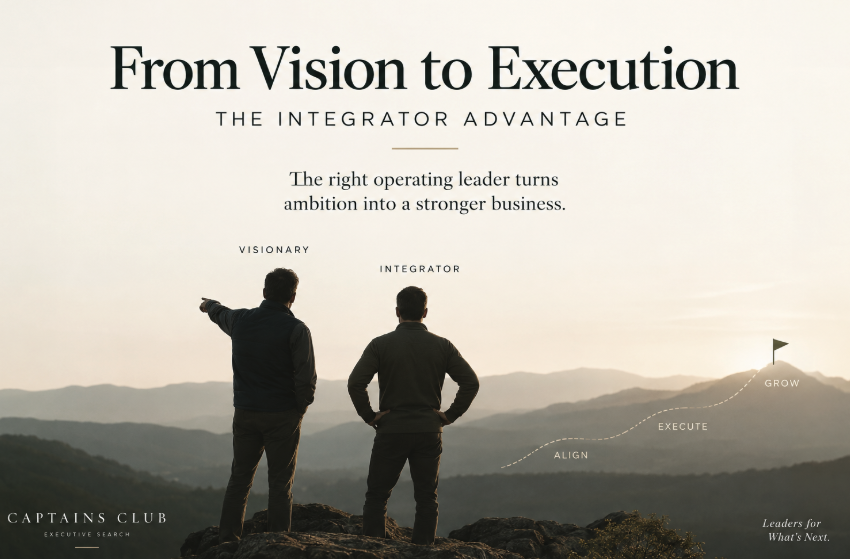
An EOS Integrator is the internal operating leader who coordinates the company’s major functions and runs daily execution. EOS Worldwide describes the Visionary as the leader who “owns the vision” and “generates ideas,” while the Integrator “runs the business day-to-day” and “holds the leadership team accountable.” Rocket Fuel names the working relationship between these roles the Visionary-Integrator pairing. EOS treats them as partners, with the Integrator executing the business plan and resolving issues across functions.
Integrator identifies a role within EOS, while COO identifies an executive title. A COO can serve as the Integrator when that executive owns company-wide execution and leadership accountability. A COO who mainly leads one function does not fill the Integrator seat merely because the title implies operating authority. An Integrator can also hold another title, such as President or General Manager.
A Professional EOS Implementer performs a different job. The Implementer works as an external teacher and facilitator who helps the leadership team adopt EOS tools. The Integrator works inside the business as the executive responsible for applying those tools through daily decisions, operating rhythms, and accountability.
Captains Club recruits the internal executive for the Integrator seat. If you hire an Implementer when your company lacks an Integrator, you receive EOS instruction, but daily execution remains without a dedicated owner.
Why founder-led companies get this search wrong
Founder-led companies get Integrator searches wrong when they treat Integrator as another name for COO. COO is a title, while Integrator describes responsibility for cross-functional execution and leadership-team accountability. A generalist COO search can surface accomplished functional leaders who lack the mandate or ability to integrate the whole business. EOS identifies this failure pattern as hiring the wrong Integrator.
A strong résumé cannot establish whether a candidate complements the Visionary. The relationship requires compatible working styles, clear decision authority, and enough trust for the Integrator to filter ideas and hold leaders accountable. Search firms that skip a Visionary-Integrator fit assessment evaluate each candidate in isolation from the person they must complement.
Some owners leave the Integrator seat vacant, which EOS calls the no Integrator pattern. Others ask a sales, finance, or operations leader to perform the role without giving that person company-wide authority. Both approaches leave the founder carrying decisions that should belong to a second-in-command.
Chronic ambiguity below the founder points to an undefined leadership seat rather than a weak candidate pool. Captains Club uses Scope & Strategy to define the Integrator’s authority, ownership, motivation, and measurable outcomes before sourcing begins. Navigating Talent then scopes the role through Head, Heart, and Helm so later candidates face a consistent standard.
What to look for in an EOS Integrator recruiter
Owners can choose among EOS-focused boutiques such as VisionSpark, Strategic Talent Partners, and Epic Search Partners. Each firm brings its own tools, assessments, and search model. EOS vocabulary alone does not prove that a recruiter can define the authority of the seat or assess its fit with the Visionary.
Ask every recruiter the same four questions before choosing a firm. Can the recruiter distinguish an Integrator from a COO title and a Professional EOS Implementer? How will the recruiter test behavioral fit with the Visionary? What evidence supports the compensation range? What written protection applies if the placement fails? Captains Club answers those questions through Navigating Talent and its Head, Heart, and Helm lenses.
Comparison table: EOS Integrator recruiter criteria vs. Captains Club
Defining the seat before the search: Bearings Report and Scope & Strategy
Captains Club defines and stress-tests the Integrator seat before approaching candidates. Scope & Strategy begins with the Bearings Report, which tests stakeholder assumptions against behavioral, market, and historical evidence. A recruiter can then assess candidates against a clear operating mandate instead of relying on a COO job description or an appealing résumé.
The Bearings Report compares three evidence streams. Stated evidence captures what stakeholders say the business needs. Measured evidence supplies behavioral data, while Observed evidence examines independent market and historical facts. Together, these streams reveal where the proposed seat conflicts with the company’s actual needs.
The report identifies four types of gaps. Stakeholder split shows where owners and leadership team members disagree about the role. Stated vs. measured compares stakeholder expectations with behavioral data. Stated vs. observed tests those expectations against market or historical evidence. Aspiration vs. history separates the role the company wants to create from the way previous leaders have operated.
Captains Club uses those findings during the Owner Alignment Session to define authority, ownership, motivation, behavioral complementarity, and measurable outcomes. The engagement then produces the role architecture, compensation benchmark, Ideal Candidate Profile, and Job Scorecard needed to run the search.
Navigating Talent gives that definition a consistent structure. Head establishes how the Integrator must think, work, communicate, and complement the Visionary. Heart defines the motivations and cultural conditions that can keep the right person engaged. Helm specifies the operating responsibilities and prior evidence required to carry them.
Sourcing begins after the seat has survived that review. Captains Club then applies Head, Heart, and Helm to each candidate using the same criteria established during scoping. The sequence prevents a common wrong-Integrator hire in which a capable executive enters an unclear seat and receives conflicting expectations after joining.
How the landscape of EOS-focused recruiters compares
EOS-fluent boutiques understand the role and bring credible assessment tools to the search. VisionSpark uses named tools for seat definition, sourcing, and behavioral fit. Strategic Talent Partners offers an Integrator sizing framework and standalone candidate evaluation. Epic Search Partners uses EOS internally and incorporates the Kolbe System with the client’s People Analyzer and Accountability Chart.
Generalist and family-business firms serve a different need. RFT Search Group recruits operational and financial leaders for owner-operated businesses, but its public materials show no EOS or Integrator-specific method. Smooth Operators focuses on operational leaders in construction and home services without presenting an EOS-specific assessment. Stranberg Resource Group brings deep family-business succession experience and structured executive integration, but it recruits conventional executive titles rather than a defined Integrator seat.
Captains Club focuses its Integrator work on founder-led businesses with $10M-$50M in revenue. Scope & Strategy defines the authority, ownership, motivation, behavioral complementarity, and measurable outcomes of the seat before sourcing begins. The Bearings Report tests stakeholder assumptions against Stated, Measured, and Observed evidence. Navigating Talent then defines and assesses fit through Head, Heart, and Helm.
Owners should compare firms based on the problem they need solved. An EOS-fluent boutique can offer relevant language and assessments. A generalist can bring industry knowledge or succession experience. Captains Club fits an owner who needs a full-time second-in-command and wants the Integrator seat resolved before recruiters begin presenting candidates.
Proof: the Tempe facilities-services placement
A Tempe facilities-services business is on track for its two most profitable quarters after hiring an EOS Integrator/COO through Captains Club. The company generates approximately $10 million in annual revenue, which places it within the founder-led market that Captains Club serves.
Captains Club scoped the operating seat before sourcing candidates. The Bearings Report compared Stated, Measured, and Observed evidence to identify disagreements and gaps around the role. Navigating Talent then defined the behavioral complement the owner needed through Head, the motivation and cultural fit through Heart, and the required operating record through Helm.
Captains Club used those same criteria to assess candidates and support onboarding. The placement shows what the method aims to produce. The owner gained an operating leader whose mandate matched the business, and the company improved profitability after the hire.
Self-check: do you need an Integrator, an Implementer, or both
Your answers to these questions indicate which seat is missing.
- Does a Professional EOS Implementer teach your leadership team the EOS tools, while nobody owns daily execution and accountability? You need an Integrator.
- Does your leadership team lack consistent EOS instruction, facilitation, or meeting discipline? You need an Implementer.
- Is a functional leader informally acting as Integrator without authority over the full leadership team, business plan, or cross-functional decisions? You likely need a properly defined Integrator seat.
- Does the founder still settle routine leadership disputes, connect departments, and chase quarterly priorities? An Integrator can take ownership of that operating work.
- Does your company need both stronger EOS adoption and an internal leader to run the business within EOS? You may need both roles. The Implementer teaches and facilitates the framework, while the Integrator leads execution inside the company.
Owners ready to define and recruit the seat can evaluate an Integrator search with Captains Club. Owners seeking detailed hiring steps should read the existing How to Hire an EOS Integrator guide.
FAQs
How does an EOS Integrator differ from a COO?
An Integrator is an EOS role, while COO is a title. An Integrator runs daily execution, connects major functions, and holds the leadership team accountable. A COO can serve as the Integrator, but the title alone does not establish the required authority or relationship with the Visionary. EOS Worldwide treats the Visionary and Integrator as complementary leadership roles.
How does an Integrator differ from a Professional EOS Implementer?
A Professional EOS Implementer works externally as a teacher, coach, and meeting facilitator. An Integrator works inside the company as the operating executive responsible for execution and accountability.
Does Captains Club replace our Professional EOS Implementer?
No. Captains Club recruits full-time Integrators and does not provide EOS implementation services. Your Implementer can continue teaching and facilitating EOS while the recruited Integrator runs daily operations.
What does Scope & Strategy cost?
Scope & Strategy costs $5,000. Captains Club credits the full fee toward a Retained Executive Search engagement if you proceed. The engagement includes an Owner Alignment Session, role architecture, an Ideal Candidate Profile, a Job Scorecard, compensation benchmarking, and a search plan.
How does compensation benchmarking work for an Integrator seat?
Captains Club benchmarks compensation after defining the seat’s authority, ownership, expected outcomes, and required operating experience. Scope & Strategy includes that benchmark, which prevents a generic COO salary range from driving an inaccurately scoped offer.
Where can I learn about the hiring process?
Captains Club’s How to Hire an EOS Integrator guide covers the detailed search and selection process.
Next step for owners evaluating an Integrator search
If you own a founder-led business in the $10 million to $50 million range and need a full-time EOS Integrator, define the seat before reviewing candidates. A résumé-first search evaluates people against untested assumptions about authority, ownership, behavioral fit, motivation, and expected outcomes.
Scope & Strategy gives you a defined, evidence-based mandate before the search begins. Captains Club uses that mandate to build the Ideal Candidate Profile and Job Scorecard that guide sourcing and assessment. Start there if the Integrator seat remains unclear, stakeholders expect different things, or previous hires have struggled to carry the operating responsibility you intended to transfer.
